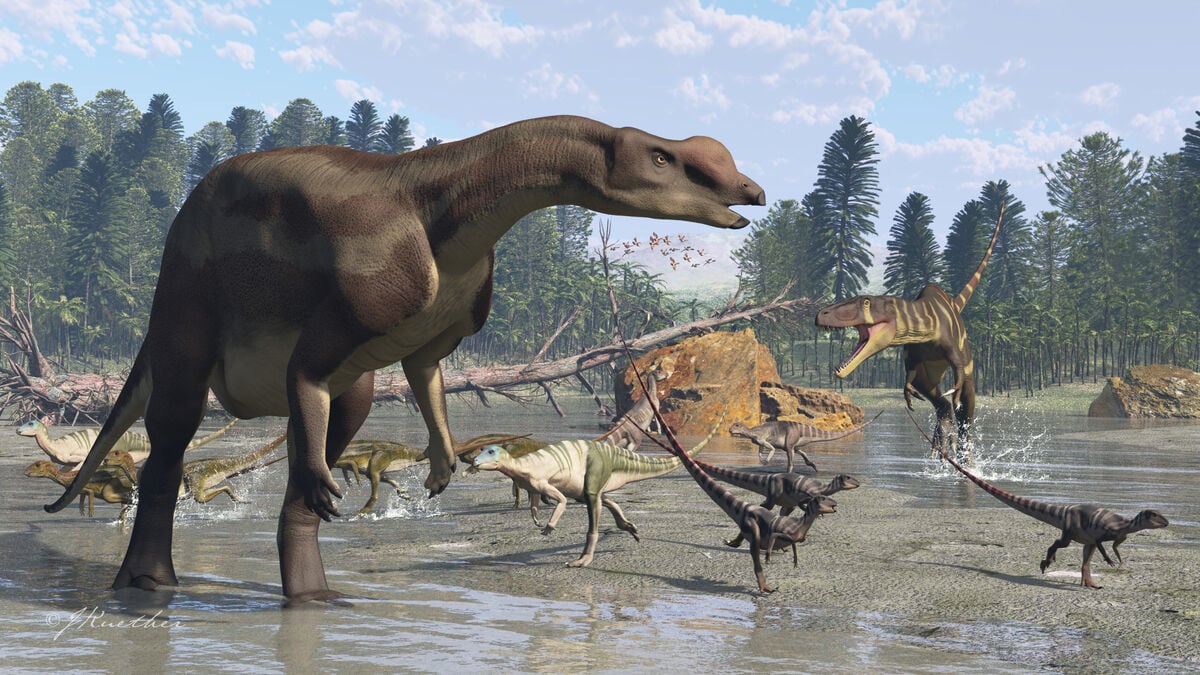
In its native Australia, Muttaburrasaurus is something of a celebrity. But outside the country, few people are likely to know about this enormous herbivore that lived 96 million years ago.
"It's unfair," says Vera Weisbecker, professor of evolutionary biology at Flinders University.
But new findings may change that. Australian and American scientists have examined fossils, which turned out to be a breeding ground for unexpected discoveries.
The snout stands out, in a double sense. It had a special bulge and a set of bones that have not been seen in any other dinosaur. Inside were large cavities.
"It probably had a lot of surface area for scents to bind to the mucous membranes. In addition, the part of the brain that processes smell was very large."
Picky about food
In fact, Muttaburrasaurus has the greatest relative sense of smell ever measured in a dinosaur, even better than T. rex, according to the researchers.
The snout is also elongated and there are teeth in the mouth, which is also unusual for this type of dinosaur. The researchers' theory is that it was picky about what it ate and used its well-developed sense of smell to find specific foods.
"We think it used its sense of smell to go through the vegetation and pick up specific things. It could be something we don't even know about, but it could also have used its nose to smell other Muttaburrasaurus that might have been nearby. We don't know much about its social life," says Weisbecker.
Sniffed salt?
Another discovery is that the balance organs indicate that it was able to move on two legs, despite weighing nine tons.
"I suspect it couldn't have run very fast, if it could run at all. It probably had a center of gravity and a lot of muscle at the pelvis, if you imagine a horse with a much larger rump, which made it easier to get up," she says.
Muttaburrasaurus lived on the coast, and may have ingested large amounts of sea salt if it ate plants. A cavity in its nose suggests it may have had to expel the excess salt.
"Many birds, like the albatross, have small salt glands where they basically excrete salt in droplets, and since Muttaburrasaurus lived by a salty sea, it definitely makes sense."
Facts: Muttaburrasaurus
Muttaburrasaurus langdoni lived in what is now Australia 96 million years ago. It is a distant relative of Iguanodon and weighed eight to ten tons.
The researchers have examined a nearly complete skull preserved in solid rock, using advanced computed tomography, neutron scanners and synchrotron radiation, and have produced high-resolution models.
The study is published in the scientific journal PeerJ.