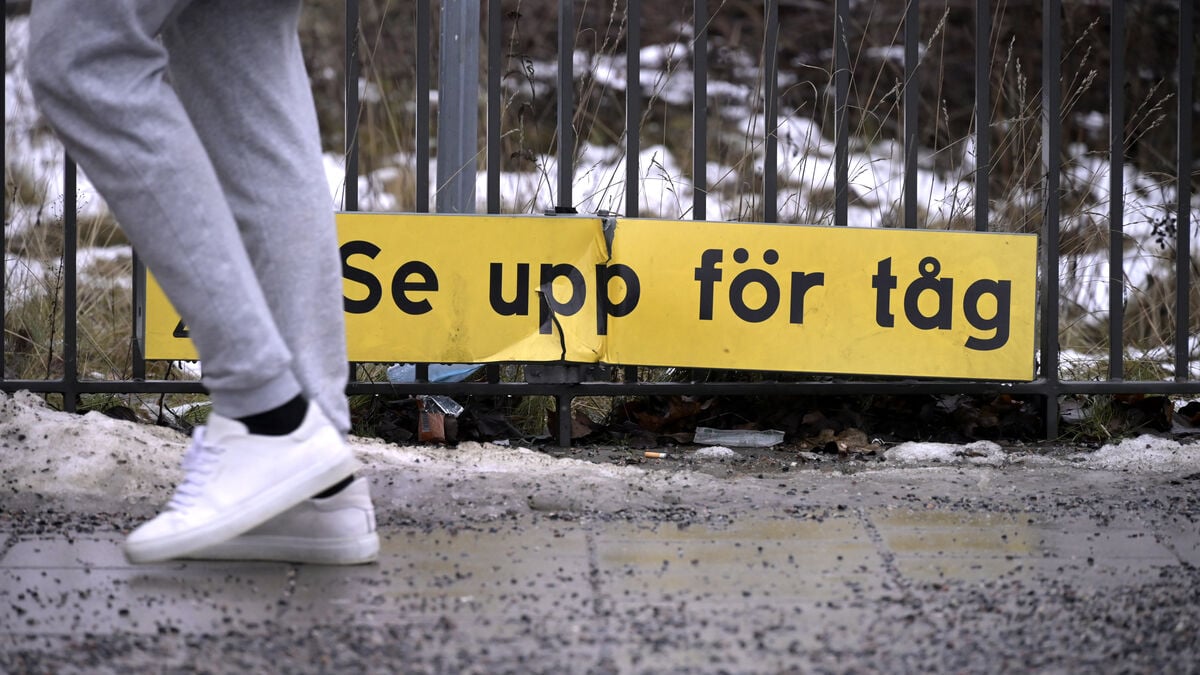
"We have come a long way, but we are not done," says Helena Rådbo, senior expert at the Swedish Transport Administration.
Since 2019, the Swedish Transport Administration, on behalf of the government, has worked to systematically increase safety at level crossings, where there is a risk of collisions between trains and other vehicles or pedestrians.
There are approximately 6,000 level crossings in Sweden, and approximately half are unprotected, that is, without barriers or sound and light signals.
106 intersections repaired
In 2019, 184 level crossings were listed as having an increased risk of accidents. 150 of them were scheduled to be repaired by 2025, but so far only 106 of them have been repaired.
It is often complex and takes time. It is the planning, land issues, procurement and cooperation with municipalities that make it take time," says Helena Rådbo.
She cannot give a year when all the intersections on the priority list will be fixed. It is not primarily a question of money, she believes, but rather that the work is so complex.
The Swedish Transport Administration cannot control everything, and not everything can be solved with money.
Despite the efforts, no clear trend is seen in the statistics on the number of fatal accidents at level crossings.
“It is unsatisfactory”
Every death is one too many, so it is unsatisfactory," says Helena Rådbo.
Fatal accidents occur at both protected and unprotected level crossings. And not all accidents can be explained by the way the crossings are designed.
People often fail to pay attention, run red lights, crawl under the barriers and don't follow the rules.
In addition to the work on the intersections on the priority list, the Swedish Transport Administration has also worked to improve visibility at approximately 500 unprotected level crossings since 2019.
Facts: How to make level crossings safer
Full barriers: This option is most common in urban areas.
Half barriers: The barriers only cover the right lane.
Own-track barriers: The barrier is kept lowered and a key is required to open it for a limited time, which is only possible if no train is on the way.
Sound and light signals:
Cross sign: Passersby are warned by a sign.
Removal: The intersection is removed.
Improved visibility: Vegetation near the intersection is cleared regularly.
Source: Swedish Transport Administration