Apart from a newly started, small-scale puppy program, there is no special breeding of search dogs for the Swedish Customs, but they come from all over the place - private individuals, hunters, other authorities who think they have a dog that would probably suit the Swedish Customs. But the dogs that sniff suitcases and cars at the border have passed a very small eye of a needle.
They often have a strong interest in objects and retrieving, and they should be friendly and socially confident, says Anna-Karin Edström Lundemo, head of the Swedish Customs' dog unit.
Sanna Häll, who is an instructor, adds more features.
They should be a little busy, have fun, have energy and need stimulation.
Just the right size
The breeds used are often those bred for hunting, such as the Labrador Retriever, Springer Spaniel and Golden Retriever, but not always. It is also important that the dog is not too big or too small. A dog that is too small will not be able to fit everywhere, while one that is too large will have difficulty in tight spaces.
On the Swedish Customs website, there is a film that shows what qualities the authority wants the dogs to have. Anyone who believes they have a dog that fits the description can register their dog for sale. Dogs that are interesting can come and do a suitability test. Those that then pass are placed as so-called subject dogs with an instructor.
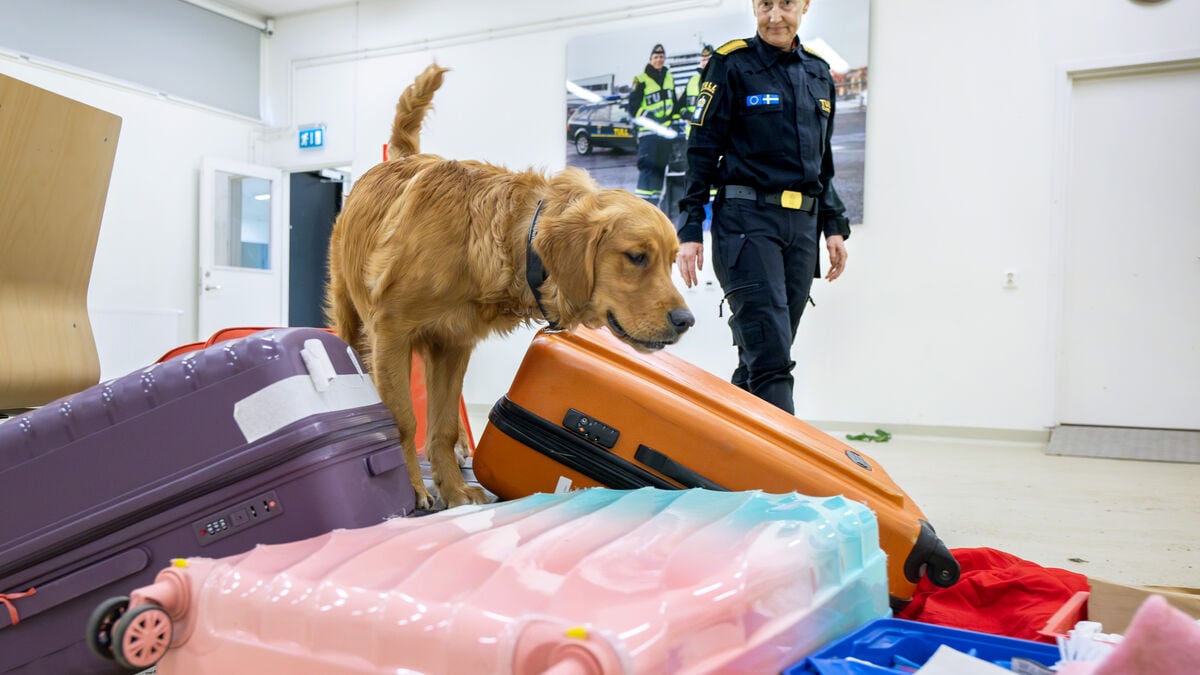
That's how far two-year-old Sting, or Scottmoor Gundogs Singleton as he's actually called, has come. He turned out to be a bit too eager to be a hunting dog and has now been living with Sanna Häll for a few months to be evaluated.
Today he gets to search for an empty shell casing, the first thing they start training the search dogs on.
Sniffing loudly
You can tell from his loud sniffing that Sting is working hard as he searches the laid-out bags. His tail wags when he finds the hidden empty shell, but otherwise he remains calm.
A long time ago, we had active marking; now we work with passive marking. The dogs stop and stand still. It's a safety feature that minimizes the risk of injury and evidence being destroyed. And it's so much easier for us, explains Sanna Häll.
Sting gets praise and his ball when he finds the empty shell.
It is important to work with the dog's natural abilities and let him keep the ball. It also reduces stress levels.
Doing fitness training
Anna-Karin Edström Lundemo's seven-month-old Castor was originally intended to be a rescue dog, but now he has just started testing life as a search dog. He has to settle for looking for a toy.
This is only the fifth time he has tried. He has not been that interested before, but was too small and lazy.
Now he gets to practice his fitness and motivation when searching. Much of what the Customs dogs search through does not contain anything they are looking for, and it is important that the dogs do not lose their appetite.
It's one of the hardest things about the job, because there's so much empty space, says Sanna Häll.
The first thing you train is the actual technique for searching, then you add more and more. The basic repertoire is drugs, weapons and ammunition, then you can also add banknotes. Today, Swedish Customs has two specialist banknote dogs.
The dogs should not only learn to sniff out specific things correctly, but also to select and refine. For example, if you train a banknote dog, you don't want it to react to individual banknotes, but to large quantities. Anna-Karin Edström Lundemo tells of an acquaintance who trained mine dogs that had to be retrained because they marked every little part in an area where there were splinters everywhere.
Reward-based training
Rewards are the foundation of all training – good behavior should be rewarded. Praise and the chance to hold a beloved toy in your mouth will go a long way. And it should continue to be fun when training turns into real work.
If they didn't think it was fun to be at work, we wouldn't have any use for them.
Whether Sting enjoys searching is one of the things we're looking at right now as he's being evaluated. Even though he likes his ball and wants to search for it - does he like searching for other things? Does he work in all environments?
Once the dogs have been deemed suitable, they are transferred to handlers to be trained together and eventually approved as a team. The bond between dog and handler is like no other, Sanna Häll confirms.
It's such a special bond. In the end, you know what the other person is thinking. And they're there for you 100 percent. You become so incredibly close.
Social curiosity - the dog's willingness to greet and socialize with strangers.
Social self-confidence - how confident the dog is with strangers and, for example, being handled by strangers.
Environmental stability - the dog must be able to work and move in different environments, such as confined spaces and stairs.
Hunting desire - the dog should purposefully follow and grab an object, such as a ball.
Prey drive - the dog's prey drive is assessed in the search work, which should be persistent, active and purposeful. When the dog finds the object it is looking for, it should value it highly.
Searching desire - the dog's desire to search for a hidden object, such as a ball.
The most desirable age for the dog is between one and two and a half years. Customs is looking for suitable individuals and not specific breeds, but mostly uses so-called hunting dog breeds.
Source: Swedish Customs.