The oasis in the Egyptian desert, about 100 kilometres west of Alexandria, could be added to the UNESCO World Heritage List. The latest discovery in the area is a well-preserved settlement from the Byzantine era, the Egyptian Ministry of Tourism and Antiquities announced.
According to researcher Diaa Zahran, head of the ministry's department for Islamic, Coptic and Jewish antiquities, the city is built around main streets running north-south, crossed by east-west streets where several open squares have been found.
Along the streets, archaeologists have found a fortified building surrounded by thick walls, several mud-brick houses and two watchtowers. In the heart of the city is an early Christian church overlooking one of the main streets.
Details of everyday life
The discovery provides unique insights into the daily lives of the city's inhabitants. Archaeologist Zahran Mahdi, head of the excavations department at the ministry, says that among other things, they have found around 200 ostraca - clay shards with text written in Coptic and Greek. The inscriptions document buying and selling transactions, correspondence and everyday details.
Several coins were also found. A number of bronze coins bear depictions of Byzantine emperors, Latin inscriptions and Christian symbols.
The gold coins found were from the reign of the Byzantine Emperor Constantius II, in the mid-4th century.
Intact graves
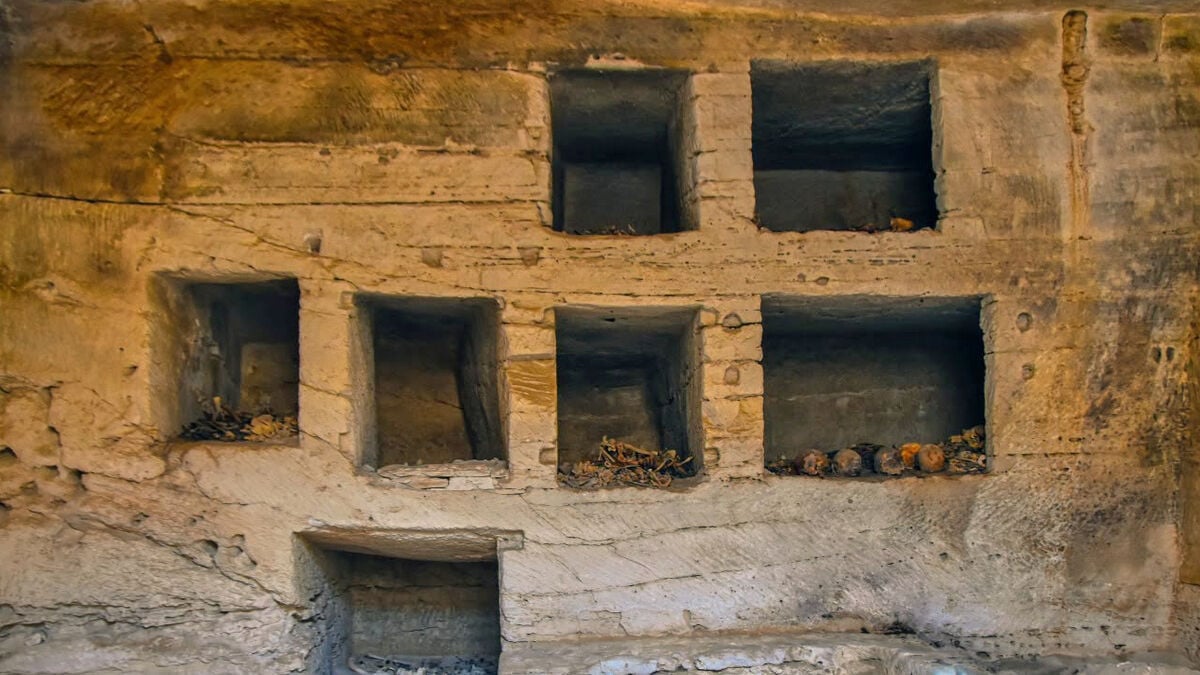
Several burial chambers were also found, with the original stone blocks that blocked the entrances still in place. A granite sarcophagus, about 2.5 metres long, had its lid intact, indicating that the tombs had been unopened for almost two millennia.
Inside the tombs, archaeologists found human remains, ceramics, amphorae and other grave goods.
The findings are not only a scientific success, but are also considered important for tourism in Egypt, a country that has been hard hit by years of political, economic and religious unrest but is now showing signs of recovery.
The Byzantine, or Eastern Roman, Empire lasted from 330 to 1453 AD. At its greatest extent, the empire encompassed half of the Mediterranean region, including the area around the Dakhla Oasis in Egypt.
The empire got its name when Emperor Constantine moved to the ancient Greek city of Byzantium in the 330s, and the power of the Roman Empire shifted eastward. When Emperor Constantine died, the city was renamed Constantinople.
Source: History of the World
Corrected: In a previous version of the fact box there was an incorrect year.